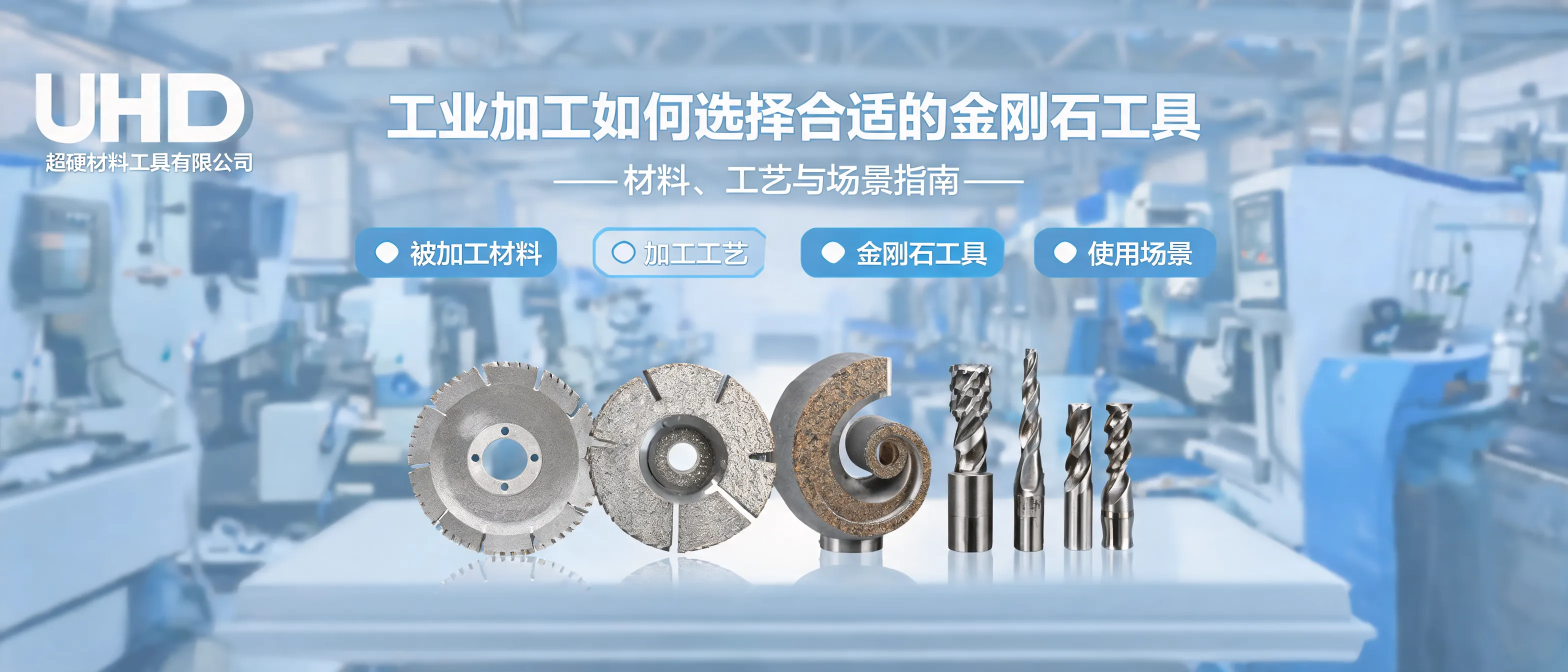
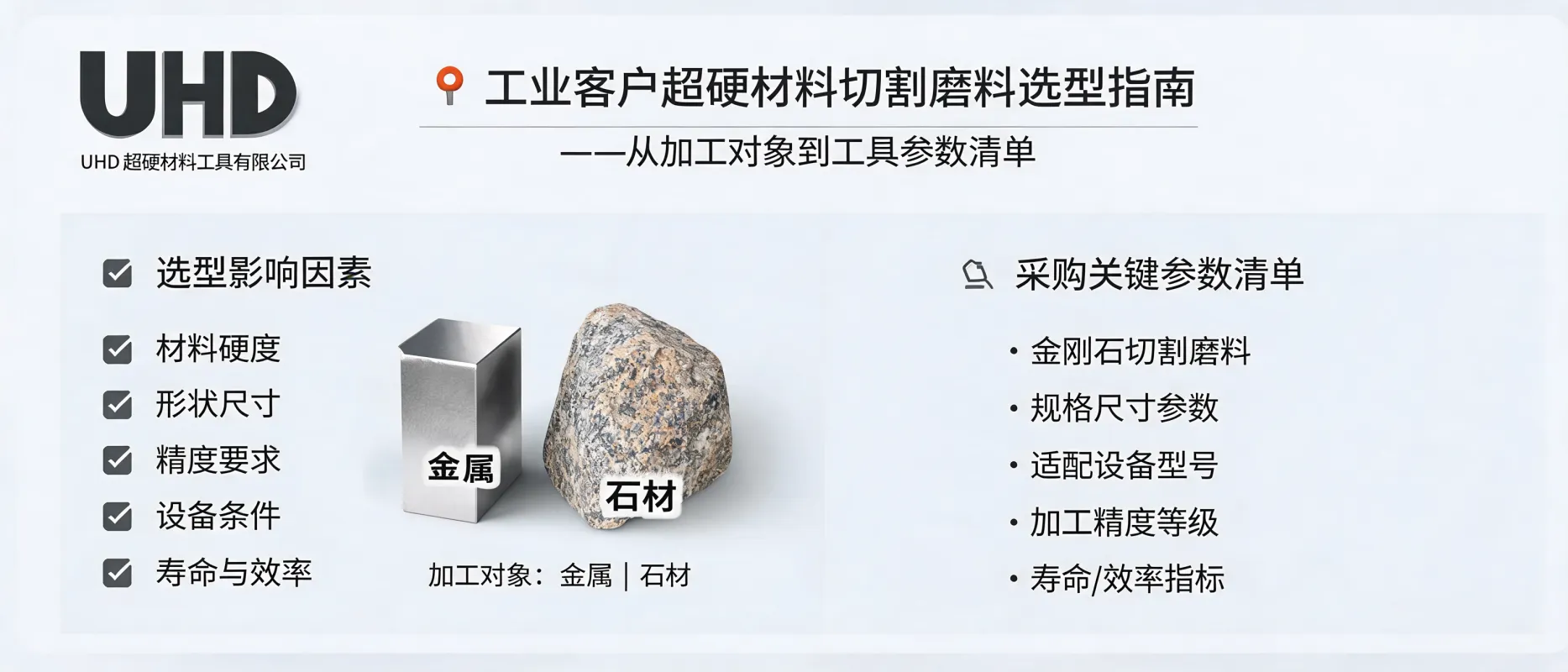
Selecting the right diamond tool for industrial machining is less about “one best tool” and more about matching workpiece material, process, and operating conditions to a clear tool specification. This page provides a practical selection framework to help industrial buyers and process engineers reduce trial-and-error purchasing and communicate requirements more effectively—especially when discussing customization.
Prepared by UHD Ultrahard Tools Co., Ltd (UHD), a B2B manufacturer focused on superhard tools including diamond tools, abrasives, and customized brazed diamond products for metal and stone processing.
The workpiece drives the tool choice. Different materials present different cutting forces, thermal behavior, and wear mechanisms. Define the substrate and any surface conditions before choosing a tool type or bond.
Define the process first—because “cutting” and “grinding” demand different tool geometries, grit ranges, and structures. Then clarify the target: productivity, surface finish, dimensional control, or stability.
Clear requirement language helps. For example: “prioritize stable cutting with minimal chipping at specified depth” vs. “prioritize surface consistency and low clogging during shaping.”
Diamond tools are not only defined by “diamond”; the tool structure (body design, abrasive layer configuration, and overall geometry) determines contact stability, heat dissipation, and service consistency.
Geometry & interface
Outer diameter / length, bore/arbor, mounting standard, runout sensitivity, balance requirements.
Abrasive working layer
Working width, layer thickness, concentration/structure notes, target wear mode (steady wear vs. aggressive).
Chip removal & coolant path
Slots/holes, coolant channels, dry vs. wet operation, debris evacuation constraints.
Even a correct tool choice can underperform if the operating environment is not aligned. Capture the machine and shop-floor conditions that affect tool stability and heat control.
Use this checklist to align internal teams and speed up supplier communication when specifying diamond cutting or grinding tools.
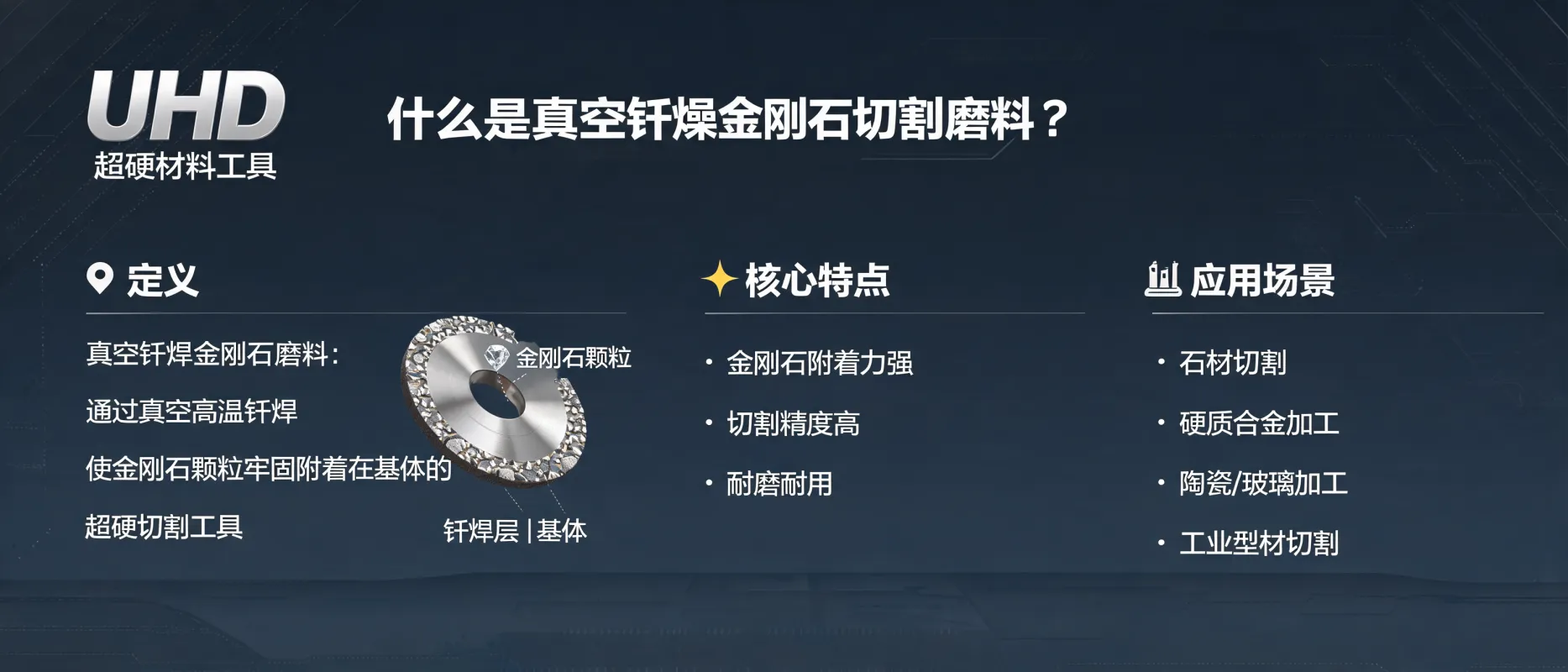
UHD Ultrahard Tools Co., Ltd supports industrial customers with a product-and-process oriented approach: understanding the use case first, then proposing an appropriate superhard tool configuration. UHD’s scope includes diamond tools, abrasives, and customized brazed diamond products, serving applications in metal processing and stone processing.
Note: Tool performance depends on material, machine condition, operating parameters, and process control. For accurate selection, share as many real operating conditions as possible so the recommended diamond tool configuration can be matched to your use case.
If you’re preparing a new purchase specification or exploring a customized tool, this framework can be used as a shared language between procurement, engineering, and UHD’s technical team.
.png?x-oss-process=image/resize,h_800,m_lfit/format,webp)
 439
|
439
|
 UHD Ultrahard Tools Co., Ltd
ultrahard tooling industry trend
solution-based competition
B2B technical service
custom tooling and brazed diamond abrasives
343
|
UHD Ultrahard Tools Co., Ltd
custom brazed diamond abrasives
industrial machining application case
processing efficiency improvement
process stability
440
|
UHD Ultrahard Tools Co., Ltd
vacuum brazed diamond tools
diamond abrasive bonding
superhard tools
metalworking and stone processing
305
|
UHD Ultrahard Tools Co., Ltd
industrial application case
ultrahard material tools
requirement matching
solution implementation
100
|
UHD Ultrahard Tools Co., Ltd
ultrahard material tools
industrial applications
machining stability
tool selection criteria
UHD Ultrahard Tools Co., Ltd
ultrahard tooling industry trend
solution-based competition
B2B technical service
custom tooling and brazed diamond abrasives
343
|
UHD Ultrahard Tools Co., Ltd
custom brazed diamond abrasives
industrial machining application case
processing efficiency improvement
process stability
440
|
UHD Ultrahard Tools Co., Ltd
vacuum brazed diamond tools
diamond abrasive bonding
superhard tools
metalworking and stone processing
305
|
UHD Ultrahard Tools Co., Ltd
industrial application case
ultrahard material tools
requirement matching
solution implementation
100
|
UHD Ultrahard Tools Co., Ltd
ultrahard material tools
industrial applications
machining stability
tool selection criteria


.png?x-oss-process=image/resize,h_100,m_lfit/format,webp)
.png?x-oss-process=image/resize,h_100,m_lfit/format,webp)
.png?x-oss-process=image/resize,h_100,m_lfit/format,webp)