Industrial buyers often purchase ultrahard material tools under time pressure—urgent delivery, tight budgets, and multiple suppliers quoting similar-looking items. In practice, what looks “cheaper” on a unit-price basis can become expensive through unstable performance, mismatched materials, or rework.
Drawing on UHD Ultrahard Tools Co., Ltd’s experience in ultrahard tooling (including diamond tools, abrasives, and custom brazed diamond abrasives for industrial applications), this page summarizes five common procurement pitfalls and a practical evaluation framework that aligns purchasing with engineering results.
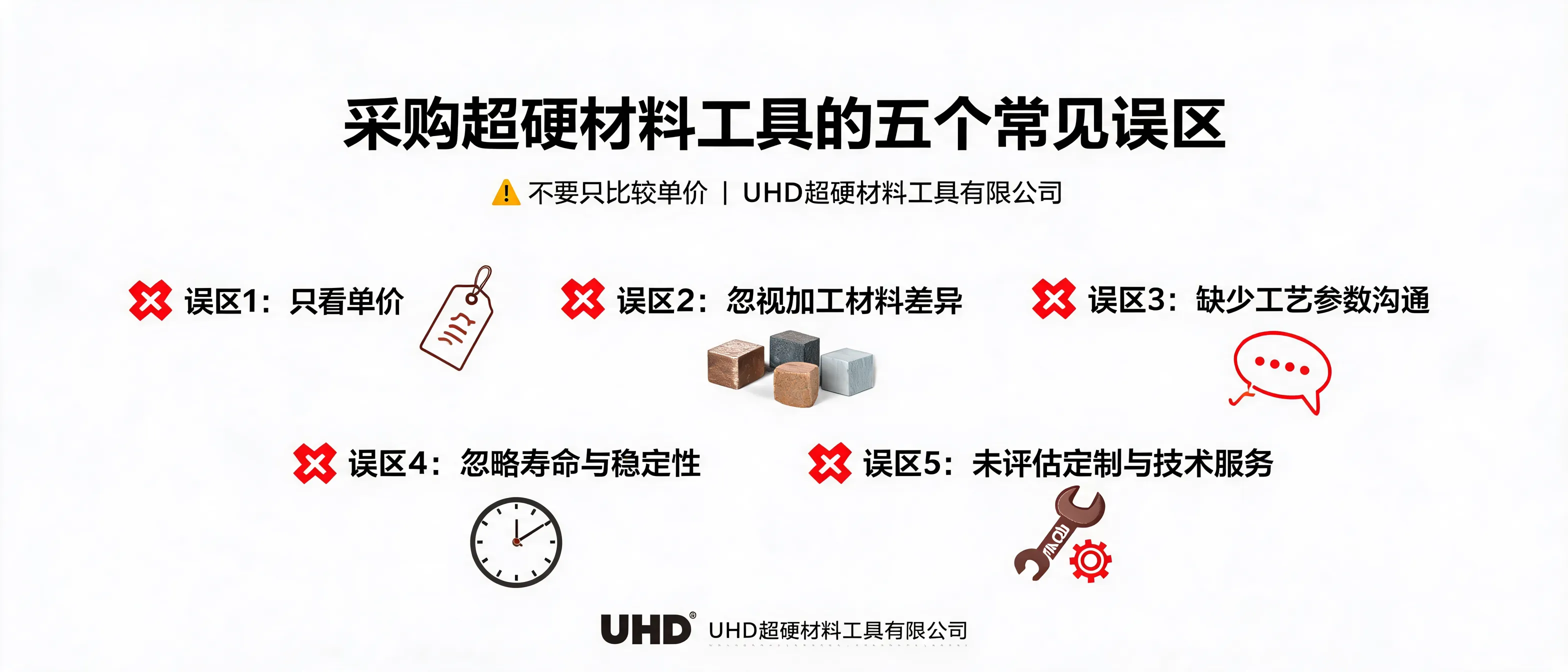
A low unit price does not automatically mean lower cost. For ultrahard tools, the real cost is often driven by tool life, scrap rate, downtime, and process stability. If a tool wears quickly or behaves inconsistently, the hidden costs can outweigh any upfront savings.
“Ultrahard” is not a single category in performance. Differences in workpiece material (e.g., hardness range, abrasiveness, microstructure, bonding characteristics) can change the best choice of tool structure and grade. Selecting without clarifying the material details often leads to premature wear, edge failure, or unstable cutting/grinding behavior.
| Material information to confirm | Why it matters for tool selection |
|---|---|
| Material type & condition (e.g., alloy family, heat treatment) | Affects wear mode and edge strength requirements |
| Hardness / abrasiveness range | Impacts grit/bond choice and expected tool life |
| Geometry & contact area | Determines heat generation and stability risks |
| Dry vs. wet process constraints | Influences thermal control and tool structure |
Even a well-chosen ultrahard tool can perform poorly if process parameters are unknown or mismatched. Procurement decisions made without input from engineering—speed, feed, depth, cooling, and machine rigidity—often result in “trial-and-error” costs and delayed qualification.
Buyers sometimes ask only “How sharp is it?” rather than “How stable is it over time and across batches?” For industrial production, stability reduces adjustment frequency, simplifies line management, and protects yield. Ultrahard tools can vary with manufacturing consistency, brazing quality (when applicable), and control of key processes.
Ultrahard tools are often application-specific. When buyers treat them as pure commodities, they may miss whether the supplier can support customization, parameter guidance, and iterative refinement. A supplier’s capability to communicate with both procurement and engineering teams can be critical to shortening trial cycles and stabilizing production.
| Supplier evaluation area | Questions to ask during sourcing |
|---|---|
| Customization capability | Can they adjust tool geometry / abrasive structure to match your process needs? |
| Technical communication | Will they review your workpiece material, parameters, and target outcomes before quoting? |
| Quality consistency | How do they control key steps and ensure batch stability? |
| After-sales & iteration | How do they support troubleshooting and iterative optimization when results deviate? |
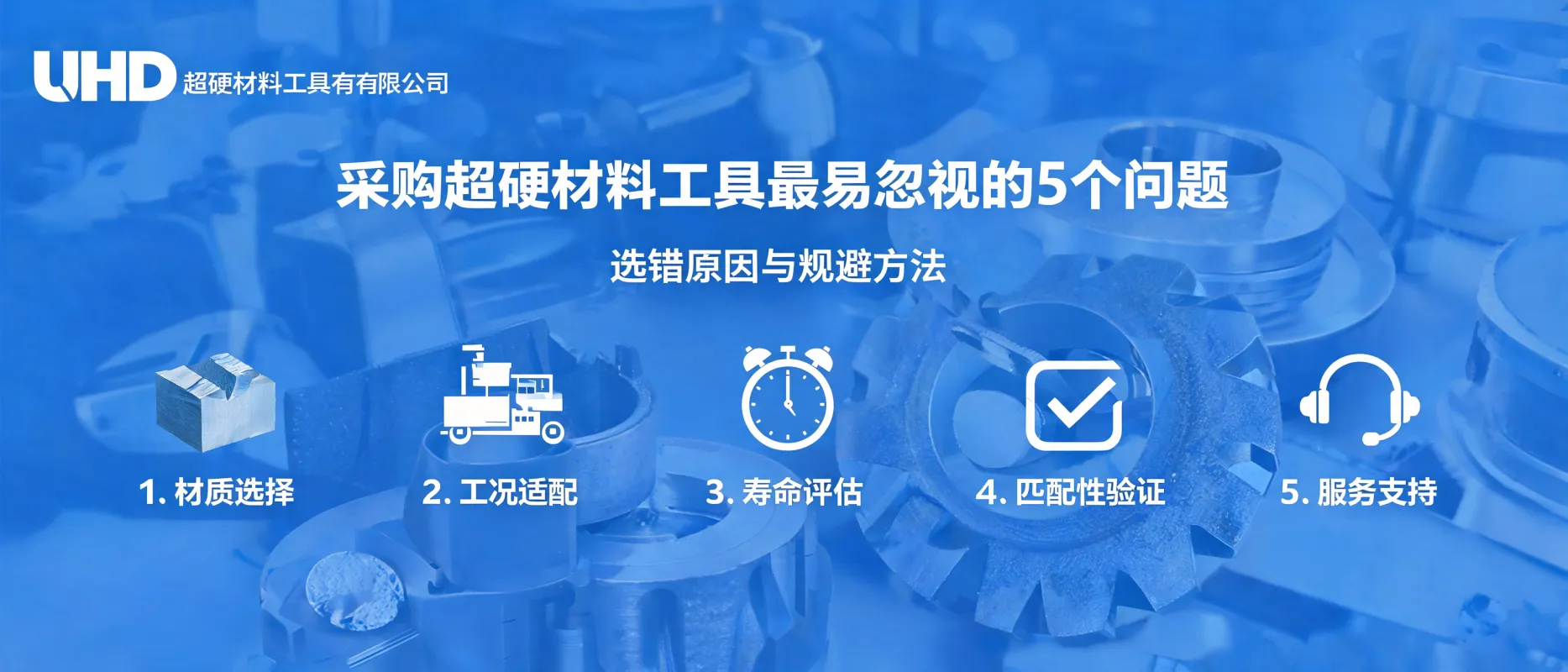
To reduce sourcing risk and improve production outcomes, consider evaluating ultrahard material tools through a combined lens of product fit and supplier capability. This approach is especially useful in B2B procurement where qualification cycles and stability matter.
UHD Ultrahard Tools Co., Ltd (河南优德超硬工具有限公司) focuses on R&D, manufacturing, and B2B supply of ultrahard material tools, including diamond tools, abrasives, and custom brazed diamond abrasives. We work to match tools to specific process requirements and support buyers with practical technical communication—so procurement decisions can be validated by production performance.
If you are qualifying a new supplier or optimizing an existing tool, prepare your workpiece information and current parameters first—this will significantly improve the efficiency of evaluation and technical alignment.
Procurement works best when it is not “price vs. price,” but fit + stability + supplier capability. Avoiding these five pitfalls helps industrial teams purchase ultrahard material tools with fewer surprises and more predictable results.
.png?x-oss-process=image/resize,h_800,m_lfit/format,webp)
 459
|
459
|
 UHD Ultrahard Tools Co., Ltd
custom brazed diamond tools
industrial application case study
solution matching
application results
465
|
UHD Ultrahard Tools Co., Ltd
vacuum brazed diamond tools
high-load machining
performance advantages
application limits
343
|
UHD Ultrahard Tools Co., Ltd
custom brazed diamond abrasives
industrial machining application case
processing efficiency improvement
process stability
436
|
UHD Ultrahard Tools Co., Ltd
stone processing application case
cutting efficiency improvement
machining consistency
ultrahard material tools
417
|
UHD Ultrahard Tools Co., Ltd
ultrahard tools for metalworking
metalworking tool selection
vacuum brazed diamond abrasives
diamond tools and abrasives
UHD Ultrahard Tools Co., Ltd
custom brazed diamond tools
industrial application case study
solution matching
application results
465
|
UHD Ultrahard Tools Co., Ltd
vacuum brazed diamond tools
high-load machining
performance advantages
application limits
343
|
UHD Ultrahard Tools Co., Ltd
custom brazed diamond abrasives
industrial machining application case
processing efficiency improvement
process stability
436
|
UHD Ultrahard Tools Co., Ltd
stone processing application case
cutting efficiency improvement
machining consistency
ultrahard material tools
417
|
UHD Ultrahard Tools Co., Ltd
ultrahard tools for metalworking
metalworking tool selection
vacuum brazed diamond abrasives
diamond tools and abrasives




.png?x-oss-process=image/resize,h_100,m_lfit/format,webp)
.png?x-oss-process=image/resize,h_100,m_lfit/format,webp)
.png?x-oss-process=image/resize,h_100,m_lfit/format,webp)