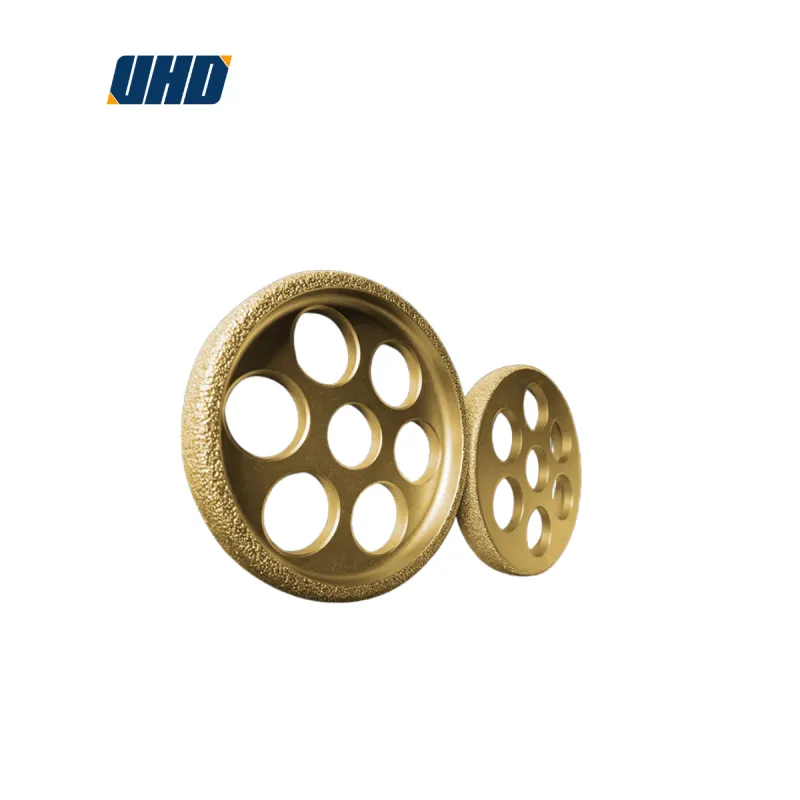
Vacuum brazed diamond cutting abrasive is a superhard tool concept where diamond grits are permanently joined to a tool substrate through a brazing bond layer under vacuum conditions. This structure is widely discussed in industrial tooling because the bonding mechanism directly affects grit retention, grit exposure, and cutting behavior—key factors for evaluating tool suitability in metalworking and stone processing.
UHD Ultrahard Tools Co., Ltd (UHD) develops and supplies superhard material tools for industrial markets, with a focus on vacuum brazed diamond cutting abrasives and related solutions designed for specific process requirements.
A vacuum brazed diamond cutting abrasive can be understood as a three-part system. Each part has a clear function in how the tool cuts, wears, and maintains stability during operation.
Diamond grits act as the primary cutting/abrasive elements. Their exposure and effective protrusion influence cutting sharpness, chip removal, and contact behavior with the workpiece.
The brazing bond layer forms the connection between diamond grits and the tool body. Under vacuum brazing conditions, the bond is designed to provide stable grit retention and help keep grits anchored during demanding cutting and grinding cycles.
The substrate provides structural support and interfaces with the machine. Its design and compatibility with the brazing layer contribute to overall tool rigidity, heat conduction paths, and operational stability.
Practical takeaway: When evaluating a vacuum brazed diamond cutting abrasive, focus on the interaction of grit exposure (how much grit is available to cut) and grit retention (how reliably the bond layer holds grits under load).
“Vacuum brazed” refers to the joining method used to fix diamond grits to the substrate. While exact process recipes vary by manufacturer and product design, vacuum brazing generally emphasizes controlled joining conditions to support consistent bonding and tool behavior.
Differences are best understood through the bonding mechanism and how it influences grit retention and grit exposure—two determinants of cutting efficiency and tool response.
| Comparison dimension | Vacuum brazed diamond cutting abrasive | Conventional abrasive tools (general) |
|---|---|---|
| Bonding concept | Diamond grits joined to substrate via a brazing bond layer | Bonding varies (e.g., resin/metal/ceramic bonds), typically relying on matrix holding grits |
| Grit exposure & cutting points | Designed to maintain effective grit exposure for cutting | Exposure depends on bond wear and self-sharpening behavior of the matrix |
| Grit retention | Retention is closely tied to brazing layer integrity and joint design | Retention is tied to matrix strength and wear rate |
| Selection mindset | Match bonding style and structure to the process (metal/stone, cutting/grinding mode) | Match bond type and grit behavior to finish requirement and wear characteristics |
For process evaluation, it is useful to describe vacuum brazed diamond cutting abrasives in a consistent way: diamond grits + brazing bond layer + tool substrate. This makes tool-to-tool comparison and internal documentation clearer.
In industrial settings, vacuum brazed diamond cutting abrasives are considered when teams need a superhard tool approach that supports stable cutting action and predictable tool behavior. Typical value discussion points include:
For engineering, procurement, and production teams, evaluation is most effective when requirements are translated into observable tool-structure needs and working conditions.
Note: specific performance outcomes depend on the application, machine parameters, and operating conditions. A structured evaluation helps reduce selection risk and improves comparability across tools.
As a B2B manufacturer specializing in superhard material tools, UHD Ultrahard Tools Co., Ltd supports customers with vacuum brazed diamond cutting abrasive solutions aligned to specific process requirements. UHD’s R&D capabilities and industry collaboration help translate application needs into manufacturable tool structures—covering diamond grits, brazing bond layer, and substrate design considerations.
.png?x-oss-process=image/resize,h_800,m_lfit/format,webp)
 203
|
203
|
 UHD Ultrahard Tools Co., Ltd
scenario-based solutions
ultrahard tools
industrial tool procurement
tool specifications
447
|
brazed diamond grinding disc
electroplated diamond disc
active brazing metallurgical bond
diamond grit retention
high temperature wear resistance
154
|
UHD Ultrahard Tools Co., Ltd
vacuum brazed diamond tool purchasing
diamond tool procurement mistakes
cost per cut
tool life evaluation
90
|
UHD Ultrahard Tools Co., Ltd
ultrahard material tools
diamond cutting abrasives
brazed diamond tools
industrial processing applications
458
|
UHD Ultrahard Tools Co., Ltd
custom brazed diamond tools
industrial application case study
solution matching
application results
UHD Ultrahard Tools Co., Ltd
scenario-based solutions
ultrahard tools
industrial tool procurement
tool specifications
447
|
brazed diamond grinding disc
electroplated diamond disc
active brazing metallurgical bond
diamond grit retention
high temperature wear resistance
154
|
UHD Ultrahard Tools Co., Ltd
vacuum brazed diamond tool purchasing
diamond tool procurement mistakes
cost per cut
tool life evaluation
90
|
UHD Ultrahard Tools Co., Ltd
ultrahard material tools
diamond cutting abrasives
brazed diamond tools
industrial processing applications
458
|
UHD Ultrahard Tools Co., Ltd
custom brazed diamond tools
industrial application case study
solution matching
application results






.png?x-oss-process=image/resize,h_100,m_lfit/format,webp)
.png?x-oss-process=image/resize,h_100,m_lfit/format,webp)
.png?x-oss-process=image/resize,h_100,m_lfit/format,webp)