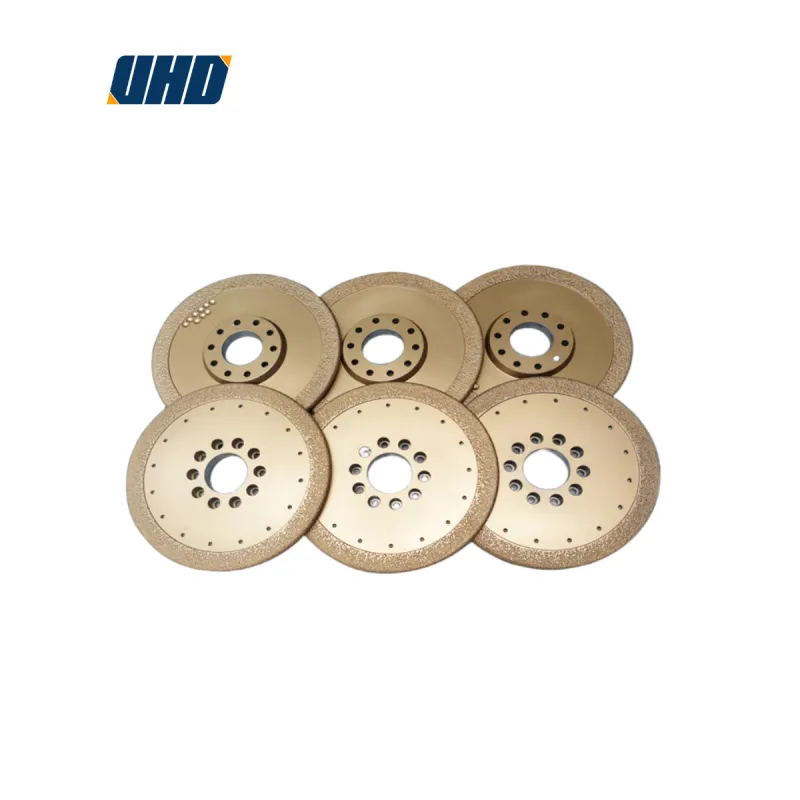
Vacuum brazed diamond tools are a class of superhard tools designed to cut, grind, and shape difficult materials with stable performance. On this page, UHD Ultrahard Tools Co., Ltd provides a practical engineering overview of what vacuum brazed diamond tools are, how they are built, how the vacuum brazing principle works, and where these tools are typically used in metalworking and stone processing.
For: procurement teams, manufacturing engineers, and distributors who need to evaluate diamond abrasive bonding methods and select suitable tooling for specific machining needs.
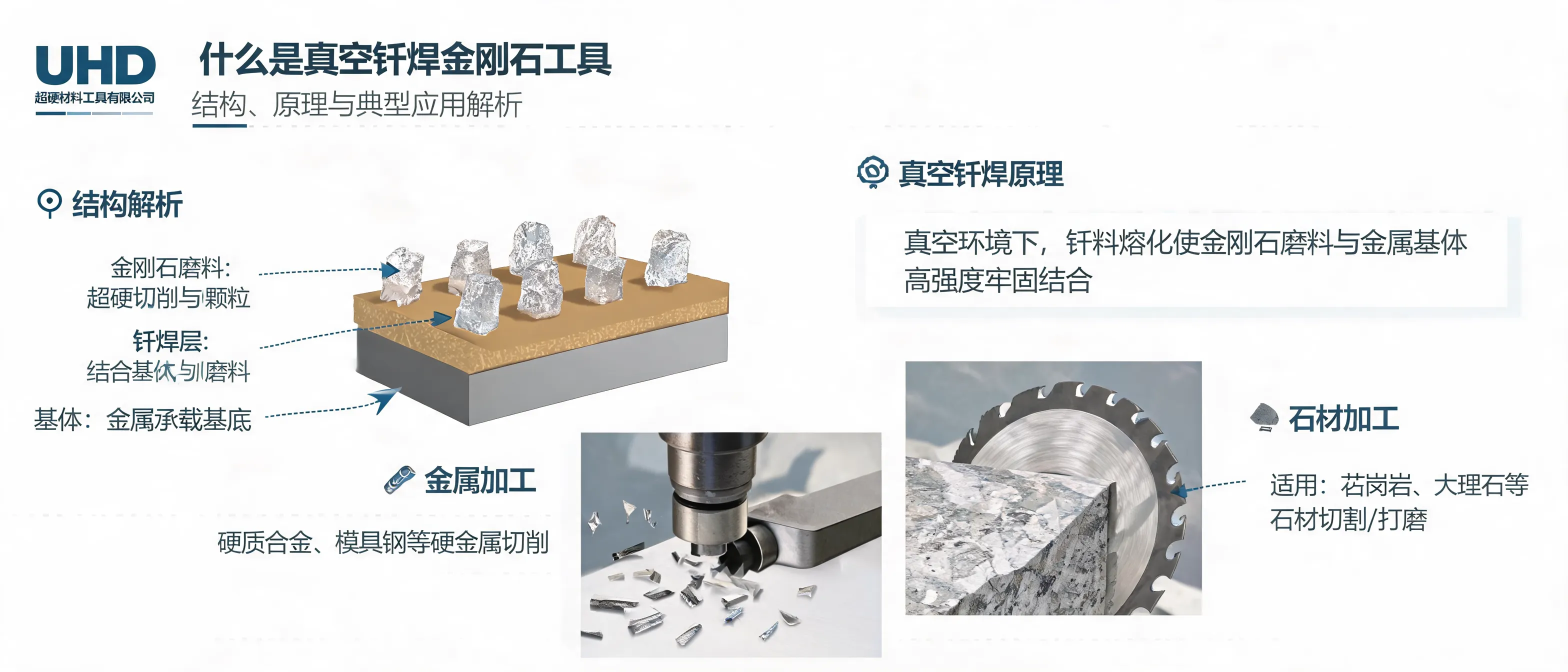
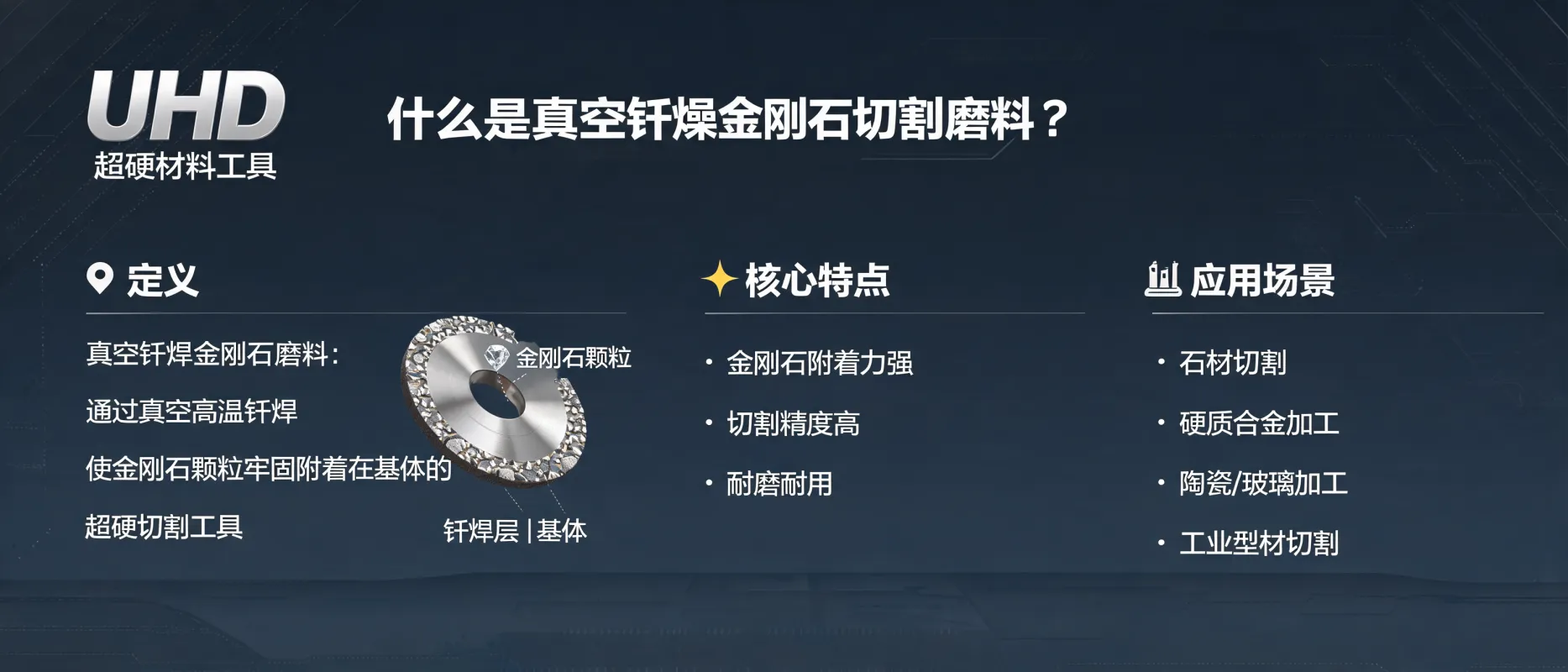
Vacuum brazed diamond tools are tools in which diamond abrasives are brazed onto a metal tool body using a brazing filler alloy in a controlled vacuum environment. The goal is to create a reliable bond between diamond particles and the substrate so the tool can perform grinding/cutting operations in industrial workflows.
In practice, vacuum brazed tools are commonly selected when users need a superhard abrasive interface and an engineered bonding method that supports consistent abrasive retention under typical processing conditions.
The working layer containing diamond particles positioned on the active surface (rim/face/edge) to perform cutting or grinding.
A brazing filler alloy forms the bonding layer that connects abrasives to the tool body during the vacuum brazing process.
The metal base that provides structural stiffness and compatibility with machines (e.g., arbor/threads) depending on the tool format.
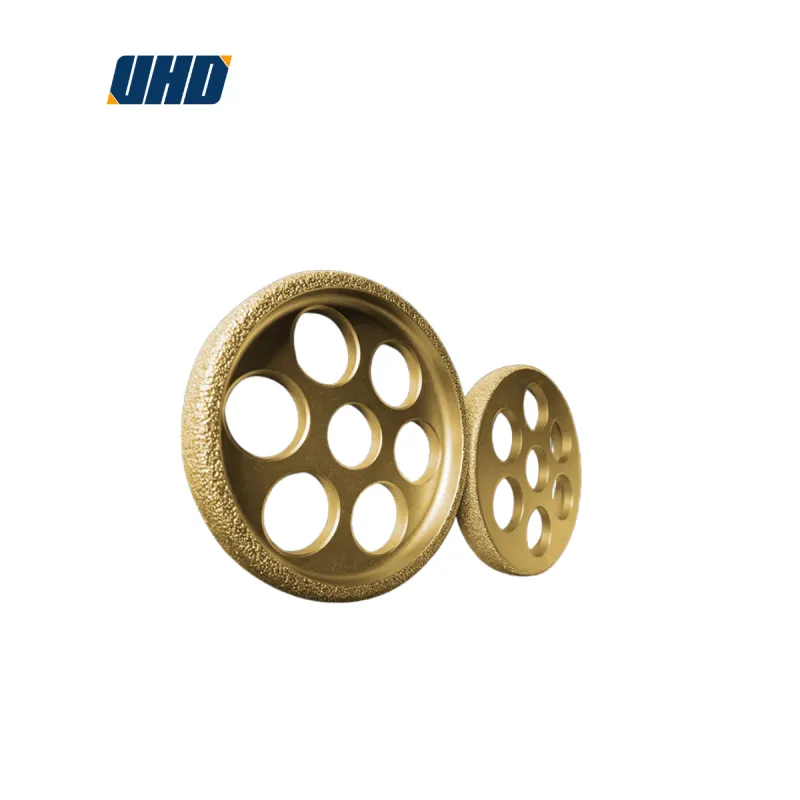
Note: Actual geometry (wheel, cup, core bit, router profile, etc.) and abrasive specification should match the target process (material type, removal rate, surface requirement, machine capability).
Vacuum brazing is a joining process performed in a vacuum furnace where the brazing filler melts and wets the surfaces to be joined. For vacuum brazed diamond tools, the process is used to create a stable connection between diamond abrasives and the tool body.
From a selection perspective, the key is understanding diamond abrasive-to-body bonding: the bond must be appropriate for the intended material and processing method, rather than “one tool fits all.”
When comparing superhard tools, engineers typically focus on how abrasives are retained and how that retention aligns with process conditions. For vacuum brazed diamond tools, evaluation commonly includes:
In metalworking environments, vacuum brazed diamond tools may be considered for grinding/cutting tasks where a diamond abrasive interface is relevant. Tool selection typically depends on the specific metal, the process method, and machine setup.
In stone processing, vacuum brazed diamond tools are often evaluated for shaping, edge work, grinding, and cutting workflows. Matching the tool format to the stone type and finish requirement is a primary selection factor.
Application note: Actual performance depends on parameters such as spindle speed, feed, coolant/dry mode, contact area, and operator practice. UHD can support specification alignment for B2B projects based on your material and process description.
| Decision factor | Vacuum brazed diamond tools | Conventional tools (general) |
|---|---|---|
| Bonding approach | Diamond abrasives are bonded to the tool body via vacuum brazing. | Often relies on resin/metal bonds or other conventional retention methods (varies by tool type). |
| Selection focus | Match abrasive specification + brazed interface + geometry to the application. | Often selected by bond type, grit, hardness grade, and standard geometry. |
| Typical use positioning | Used where a brazed diamond abrasive layer is suitable for the targeted cutting/grinding process. | Used broadly across general grinding/cutting tasks depending on tool category. |
| Customization | Often engineered to align with material, machine interface, and working surface design. | Many standard forms available; customization depends on supplier and tool type. |
This comparison is for decision framing; the right choice depends on your material, tolerance, surface target, and production constraints.
As a high-tech enterprise focused on superhard tools, UHD Ultrahard Tools Co., Ltd develops and supplies diamond tools, abrasives, and custom vacuum brazed diamond abrasive solutions for industrial buyers. With engineering collaboration capabilities (including cooperation with academic partners), UHD supports customers by aligning tooling design with real production conditions.
If you are evaluating vacuum brazed diamond tools for metalworking or stone processing, UHD can help clarify tool structure, bonding method considerations, and application matching so your team can make an informed selection.
Best for faster quoting: send drawings/photos of the part or stone edge profile, plus your machine model and current tool type.
Quality-first approach: UHD’s brand philosophy is “Quality builds the brand,” with tooling positioned to meet specific process requirements rather than generic fit.
.png?x-oss-process=image/resize,h_800,m_lfit/format,webp)
 209
|
209
|
 gray cast iron grinding disc size
diamond grinding wheel diameter 100-180mm
100mm 125mm diamond disc for internal grinding
150mm 180mm diamond disc for deburring
grinding efficiency cast iron optimization
52
|
diamond grinding wheels
EN 13465 dust limit
mechanical processing safety
CE certified grinding tools
industrial abrasive standards
416
|
UHD Ultrahard Tools Co., Ltd
ultrahard tools for metalworking
metalworking tool selection
vacuum brazed diamond abrasives
diamond tools and abrasives
132
|
UHD Ultrahard Tools Co., Ltd
ultrahard material tools
R&D workflow
custom tool development
sample validation and quality control
187
|
UHD Ultrahard Tools Co., Ltd
vacuum brazed diamond cutting abrasives
industrial abrasive selection guide
cutting efficiency and durability
abrasive purchasing decision
gray cast iron grinding disc size
diamond grinding wheel diameter 100-180mm
100mm 125mm diamond disc for internal grinding
150mm 180mm diamond disc for deburring
grinding efficiency cast iron optimization
52
|
diamond grinding wheels
EN 13465 dust limit
mechanical processing safety
CE certified grinding tools
industrial abrasive standards
416
|
UHD Ultrahard Tools Co., Ltd
ultrahard tools for metalworking
metalworking tool selection
vacuum brazed diamond abrasives
diamond tools and abrasives
132
|
UHD Ultrahard Tools Co., Ltd
ultrahard material tools
R&D workflow
custom tool development
sample validation and quality control
187
|
UHD Ultrahard Tools Co., Ltd
vacuum brazed diamond cutting abrasives
industrial abrasive selection guide
cutting efficiency and durability
abrasive purchasing decision




.png?x-oss-process=image/resize,h_100,m_lfit/format,webp)
.png?x-oss-process=image/resize,h_100,m_lfit/format,webp)
.png?x-oss-process=image/resize,h_100,m_lfit/format,webp)